Design
Asked once
An escalation the owner has answered no longer stops the same job a second time. The Factory now pushes a phone notification when a job needs a person or merges, and its own checks refuse a duplicate plugin version.
Chronicles / The Factory
Active · Oct 2026 to present
One feature in, one merged pull request out: the pipeline every project's slices now go through.
The Factory is not a product. It is the owner's build tooling: a Claude Code skill that takes a single feature description from a project's manager and turns it into a merged pull request with almost no one in the loop. A spec-writer turns the feature into a spec the manager approves; a builder works in its own worktree and opens the pull request; reviewers for security, code, user experience and visual design read it in parallel, and since 22 October a verifier actually runs it; the builder gets up to two rounds to fix what they find; an approver checks the continuous-integration result and a list of guarded paths; and then the pull request merges itself, or stops and waits for the owner.
It has no manager of its own. The manager for trevorpaugh.com tends it, because the one window into it, a read-only dashboard of every job in every project, lives on that site behind the private sign-in. The first job went through on 20 October, on the site itself. Three days later every open project was sending its slices through it.
An escalation the owner has answered no longer stops the same job a second time. The Factory now pushes a phone notification when a job needs a person or merges, and its own checks refuse a duplicate plugin version.
A repository can tell the Factory how to deploy and which address to check, so a merged job reports whether it is actually live. Ideas the reviewers leave behind become planned jobs, and with queue mode on, the Factory starts the next one by itself after a merge.
The user-experience and visual-design reviewers now look at the tester's screenshots instead of only the code, and a job that changes the interface cannot pass without a capture.
The Factory's job store, site sync and launch are typed tools now, served by a small server inside the plugin, instead of PowerShell command lines quoted by the agents. Two hardening fixes followed from the same job's review.
The Factory can push every job and spec to a website's job store as it works, so the board on trevorpaugh.com shows what the pipeline is doing right now instead of what was last synced by hand.
The dashboard's job cards now show all five reviewers in order: security, code, verifier, user experience, visual design. A job that skipped verification says so in a word. It merged with nobody watching, the first job to do so under the rule set the day before.
The dashboard's Review column was about to get wider to fit five reviewer cards side by side. The owner drew something better: the five cards for one job stack like a deck, fan out when clicked, and fold back when you click away. A second rule from the same look at the live board: no cell is ever more than three cards high, and a merged job shows only its number and title.
A fifth reviewer joined the line: a verifier that checks out the builder's branch, runs the feature as the spec describes it, and reports what it actually did. The other four read the diff. This one uses it. Green tests had turned out to be a weaker promise than they looked.
A few hours after asking for it, the owner cancelled the stacked, fanning deck of reviewer cards. The Review column already showed one card per job with a row of small reviewer badges on it, which turned out to be the better design. The column stays as it is, and the job to build the deck is dropped.
The dashboard's second round of fixes merged after one review: no cell on the board is more than three cards high, a merged job's card shows only its number and title, and a job whose spec is written but not started now carries a still grey dot instead of looking like it is running. The owner asked for all three after reading the live board.
A new rule for every hold: when a job stops for the owner, it comes with a full note on what went wrong and what the owner can actually do about it, not just a status. A held job with no way forward is the same as a stuck one.
The pilot job ran on the site itself: a small change to the new dashboard so that its cards show the job's title rather than the raw feature text. It went through spec, build, review and approval and merged the next day. Within three days every open project was sending work through the line: twenty-six jobs across five projects, fourteen merged, three waiting on the owner.
The Factory's dashboard was decided today: of the mockups on offer the owner chose the board layout, then dropped the approve and rework buttons from it. The page shows every job in every project and lets the owner do nothing to them; a hold is cleared from the keyboard, where the job files are. Job state stays on the owner's machine and is pushed to the site behind the private sign-in.
The Factory was written as a fixed pipeline: a spec-writer, a builder in its own worktree, four reviewers reading in parallel, up to two fix rounds, an approver, then auto-merge or a hold for the owner. The owner decided six rules up front, from which models do which job to the one rule that only they can clear a hold.
The Factory was written as a fixed pipeline: a spec-writer, a builder in its own worktree, four reviewers reading in parallel, up to two fix rounds, an approver, then auto-merge or a hold for the owner. The owner decided six rules up front, from which models do which job to the one rule that only they can clear a hold.
Read the entryEvery project's slices go through it.
The Factory's dashboard was decided today: of the mockups on offer the owner chose the board layout, then dropped the approve and rework buttons from it. The page shows every job in every project and lets the owner do nothing to them; a hold is cleared from the keyboard, where the job files are. Job state stays on the owner's machine and is pushed to the site behind the private sign-in.
Read the entryOverly complex for little gain.
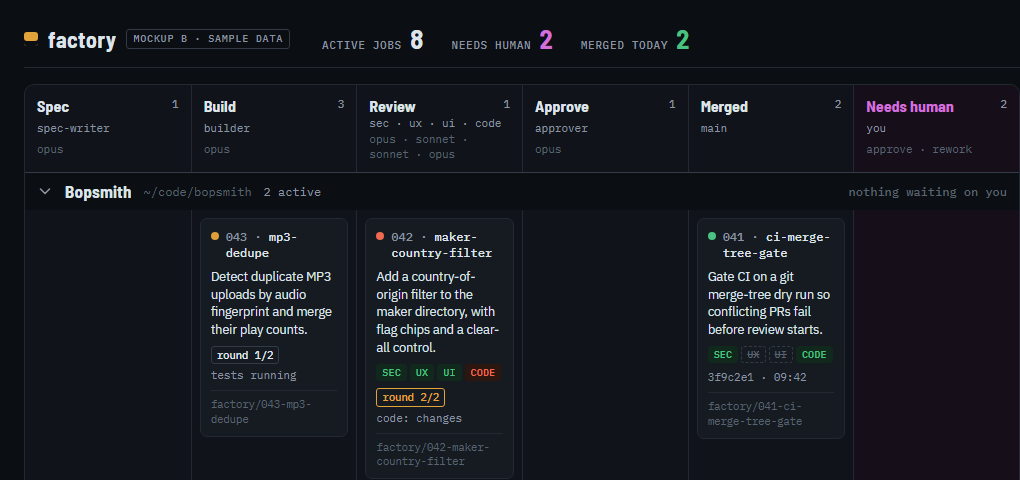
The pilot job ran on the site itself: a small change to the new dashboard so that its cards show the job's title rather than the raw feature text. It went through spec, build, review and approval and merged the next day. Within three days every open project was sending work through the line: twenty-six jobs across five projects, fourteen merged, three waiting on the owner.
Read the entryA new rule for every hold: when a job stops for the owner, it comes with a full note on what went wrong and what the owner can actually do about it, not just a status. A held job with no way forward is the same as a stuck one.
Read the entryEvery needs-human comes with a full explanation of how the user can actually help.
The dashboard's second round of fixes merged after one review: no cell on the board is more than three cards high, a merged job's card shows only its number and title, and a job whose spec is written but not started now carries a still grey dot instead of looking like it is running. The owner asked for all three after reading the live board.
Read the entryIt's not fair to say the spec column items are actually running. Most of them are just specs that have been written, but I see no active sessions working on them.
A few hours after asking for it, the owner cancelled the stacked, fanning deck of reviewer cards. The Review column already showed one card per job with a row of small reviewer badges on it, which turned out to be the better design. The column stays as it is, and the job to build the deck is dropped.
Read the entryI didn't realize how the review column already worked with just one card that had little badges on it. I like that better.
A fifth reviewer joined the line: a verifier that checks out the builder's branch, runs the feature as the spec describes it, and reports what it actually did. The other four read the diff. This one uses it. Green tests had turned out to be a weaker promise than they looked.
Read the entryTests passing is not the same as the feature working as meant.
The dashboard's Review column was about to get wider to fit five reviewer cards side by side. The owner drew something better: the five cards for one job stack like a deck, fan out when clicked, and fold back when you click away. A second rule from the same look at the live board: no cell is ever more than three cards high, and a merged job shows only its number and title.
Read the entryClicking on the stack has some cool animation where they fan out side by side for you to view.
The dashboard's job cards now show all five reviewers in order: security, code, verifier, user experience, visual design. A job that skipped verification says so in a word. It merged with nobody watching, the first job to do so under the rule set the day before.
Read the entryThe Factory can push every job and spec to a website's job store as it works, so the board on trevorpaugh.com shows what the pipeline is doing right now instead of what was last synced by hand.
Read the entryThe Factory's job store, site sync and launch are typed tools now, served by a small server inside the plugin, instead of PowerShell command lines quoted by the agents. Two hardening fixes followed from the same job's review.
Read the entryThe user-experience and visual-design reviewers now look at the tester's screenshots instead of only the code, and a job that changes the interface cannot pass without a capture.
Read the entryA repository can tell the Factory how to deploy and which address to check, so a merged job reports whether it is actually live. Ideas the reviewers leave behind become planned jobs, and with queue mode on, the Factory starts the next one by itself after a merge.
Read the entryAn escalation the owner has answered no longer stops the same job a second time. The Factory now pushes a phone notification when a job needs a person or merges, and its own checks refuse a duplicate plugin version.
Read the entry