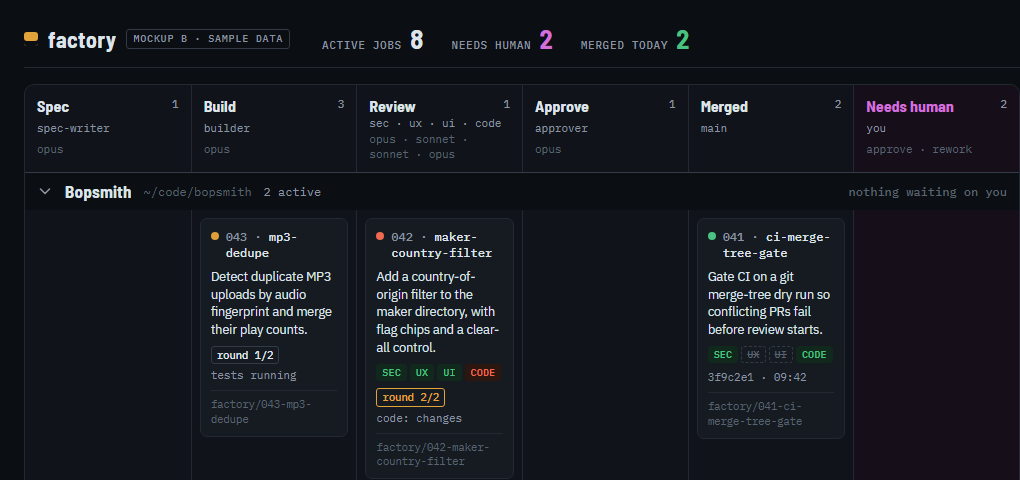
Once the pipeline existed, the question was how the owner would watch it. Jobs run on the owner’s machine, across several projects, and the only record of each is a small file on disk.
The choice
The site’s manager drew up mockups. The owner picked the board: one row per project, one column per stage, a job card moving left to right from spec to merged, and a column at the end for anything that needs a human. Then they took something away. The first version of that board had approve and rework buttons on every held job. The owner cut them: overly complex, they said, for little gain. A hold is cleared with a command on the machine where the job lives, and the page only shows that it happened.
What that settles
The dashboard is read-only. Nothing on the site can start, stop, or change a job. The machine pushes its job state up to the site on a schedule, the site stores it, and the page behind the private sign-in draws it. There is no path back down. For a public site that is the right shape: the window can show everything, because it cannot touch anything.
Next
The page itself, on the site manager’s list after the private area that will hold it.