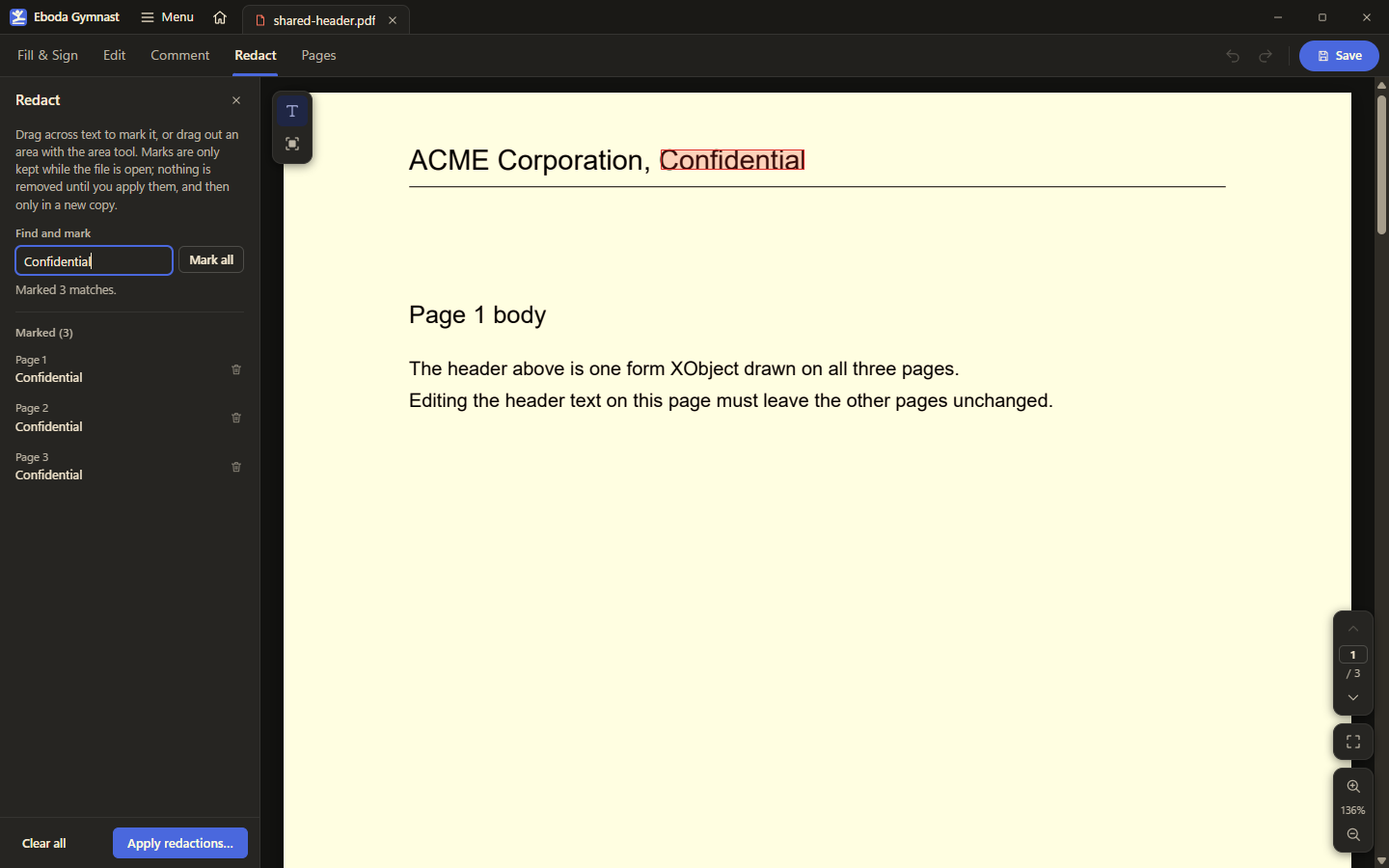
The owner had put compression and redaction at the end of the list, to be fitted in wherever they would go. They went in last and took the longest, because redaction is the one feature where every bug is a disclosure.
Compress
Compress makes a smaller copy under a new name and never touches the original. The dialog offers a choice of image resolution and JPEG quality, and a set of things to strip: objects left behind by earlier edits, page thumbnails that viewers draw for themselves, duplicate images and fonts stored once and shared, and the private data other programs tuck into a file for their own use. A preview shows the size before and after. It refuses to run over an unsaved password change, the same rule redaction follows.
Four rounds on redaction
The first round, already chronicled, found four leak paths: text in repeating fill patterns, a substring exemption, documents embedded more than one level deep, and outlined glyphs crossing the mark. The second found two more. Attachments could hide in objects the file never declared as attachments, and one exclusion in the scan still let a short term through when it sat inside a longer visible word. The third round turned the other way and found two cases of over-redaction: forms drawn without the caller’s stroke settings, and patterns stripped wherever their plane met a mark rather than only under it. The fourth round approved, with two low findings fixed in the same pass.
The line held throughout: every finding is fixed, none is written down as a limit, and if the self-check cannot prove a term is gone the copy is refused rather than written. The reviewer’s checks, some fifty of them, stayed in the suite alongside the builder’s own, and the project now runs several hundred tests on each side of the app.
Next
A fresh build and installer from the merge go to the owner. With this batch, everything the owner ordered from the Acrobat list on 13 October is on main.