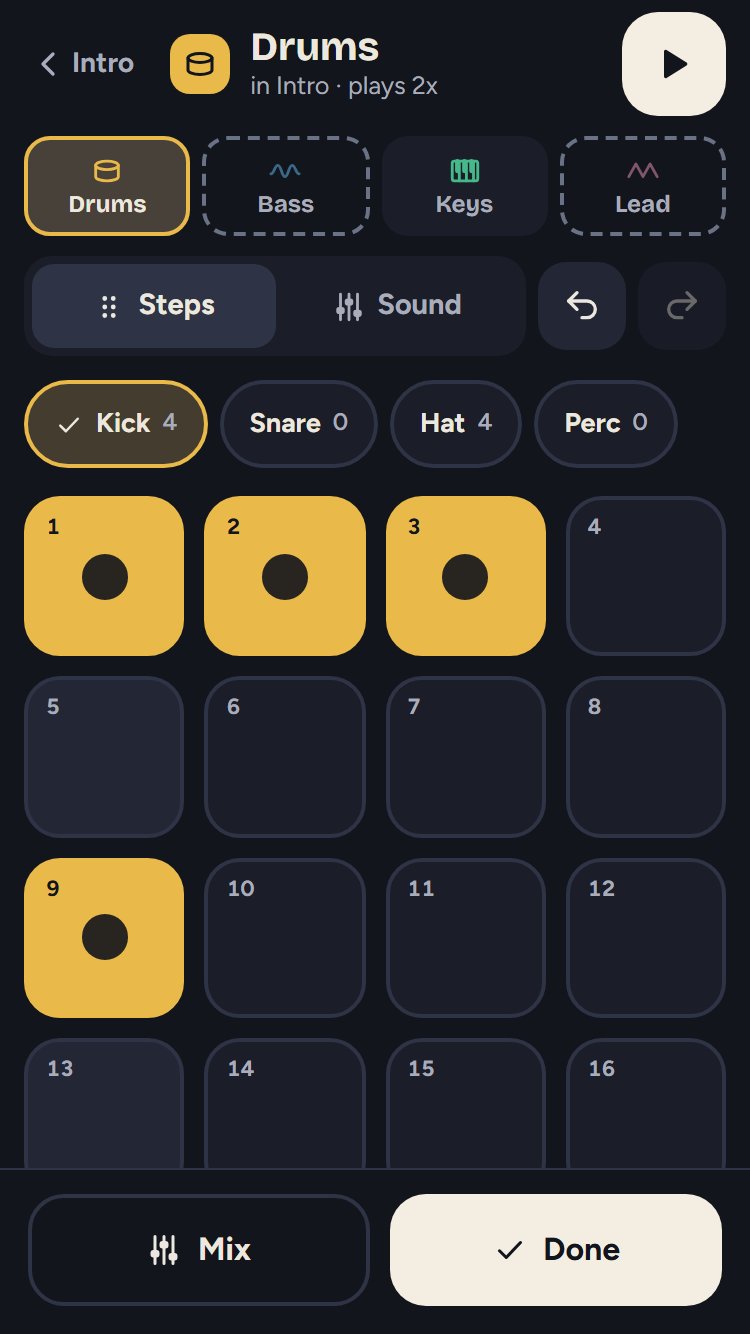
With drag-to-move settled, the owner picked the next two items from the parked list, and the manager folded in two more that had been waiting since the editor redesign.
The four
- Paint. A lit pad moves; an empty pad starts a stroke. Every empty pad the pointer crosses lights up and plays its preview, lit pads are left alone, and the whole stroke is one undo step no matter how slow it is. On touch it begins after the same quarter-second hold as a drag, so a swipe still scrolls. On desktop a drum stroke can run across lanes, each pad taking its own lane’s voice.
- Copy from another section. A new action on a section card, and on the pattern screen, opens a sheet that asks which instrument and lists every other section with a pattern for it, with a sixteen-pad miniature of each. Choosing one replaces the pattern in one undo step, with an Undo on the toast.
- Legend. Under the sections on the phone, each instrument’s icon tile in its colour with its name, so the colours on the cards mean something to a first-time visitor.
- Keyboard. The pad grid is a single focusable grid: arrow keys move, space toggles, and the focused pad is drawn with a visible ring.
Two things that were not built
Grouping repeated drags into one undo was rejected because the owner wants one undo per drag. Swipe dots and a tempo note were dropped as well, since the editor has no swipe tabs and tempo already has its place.
The budget, again
The builder first made room in the store’s first-load budget by lazily loading the pattern screen. The manager reversed that: a pad can be the first thing a visitor taps, and the size rule exists to keep that fast. Instead the store budget was raised once, by one kilobyte, with the reason recorded. Known gaps went on the list: painting is not discoverable without a hint, the arrows do not wrap at the grid’s ends, and the copy sheet’s instrument chooser is reachable only by Tab.